Chasing the Ramadan Crescent: Who Can See the New Moon of February 2027, and Who Can't
The start of Ramadan and the date of Eid can depend on spotting a sliver of Moon only a day old. We worked out how high and how thin it will be at sunset from Mecca to Jakarta to San Antonio.
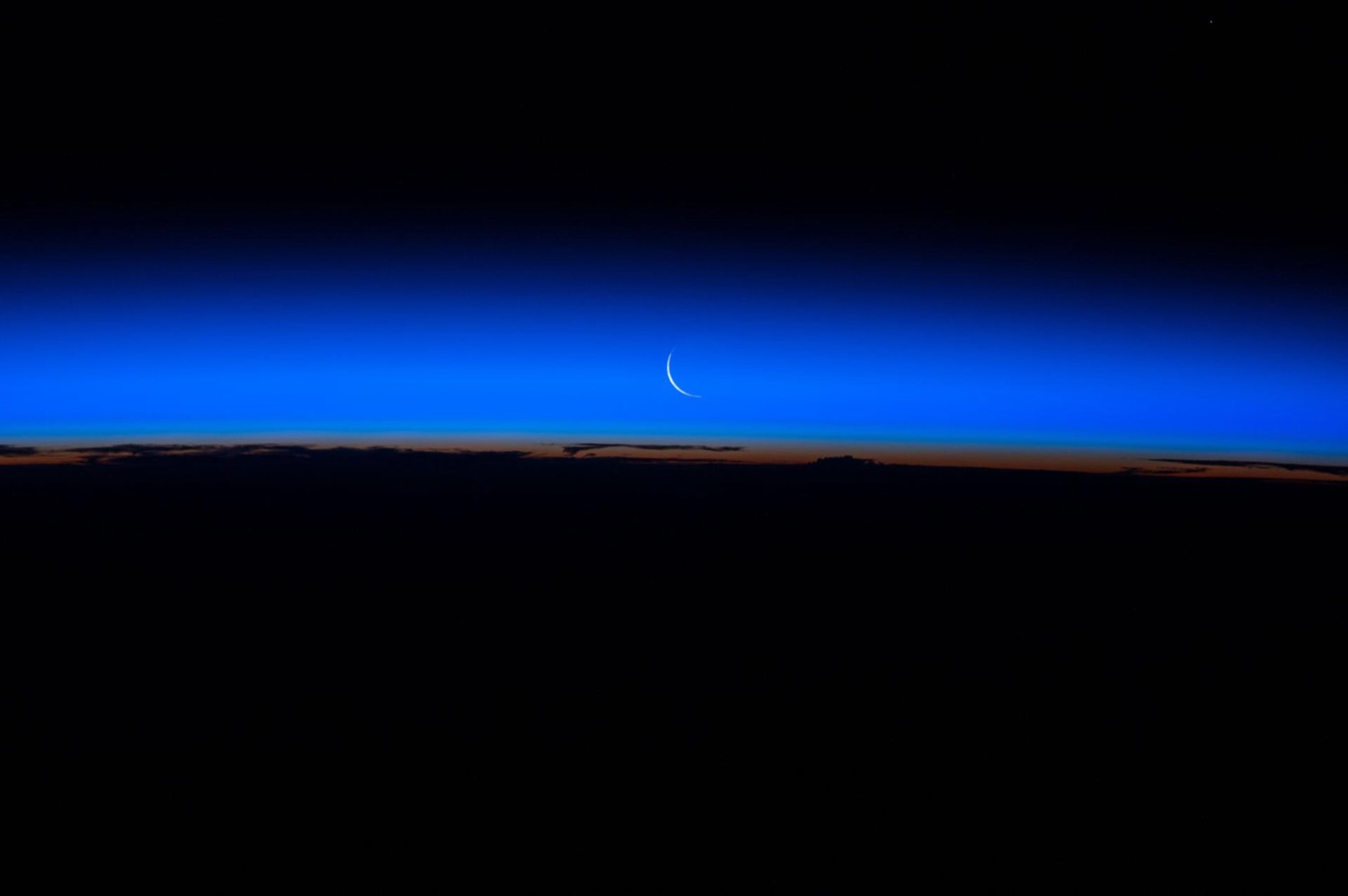
A crescent Moon setting behind Earth's atmosphere, photographed from the International Space Station by astronaut Terry Virts in March 2015.
Photo: NASA/Terry Virts (public domain)
For hundreds of millions of people, the most important astronomical observation of the year isn't a meteor shower or an eclipse. It's a thin curve of light, low in the west, a few minutes after sunset. In much of the Muslim world, the new month, and with it the start of Ramadan or the arrival of Eid, begins when that first crescent is seen.
It's a genuinely hard thing to see. Here is what the sky offers in February and March 2027.
New Moon isn't the same as the first crescent
At the moment of new Moon, the Moon sits almost in line with the Sun, and its lit side faces away from us. You can't see it at all. Over the next day or so it moves away from the Sun, about 12 degrees a day, and a sliver of sunlight starts to show on its edge.
Whether you can actually see that sliver depends on three things: how many hours old the Moon is, how far it sits from the Sun (the elongation), and how high it is above the horizon when the sky gets dark enough. A Moon less than about 7 degrees from the Sun is generally considered impossible to see by any means, because the crescent is too thin to form a continuous arc. That limit is named after the French astronomer André Danjon.
Ramadan 2027: the February crescent
The new Moon falls on February 6, 2027 at 15:56 UTC. We calculated the Moon's position at sunset on February 7 for a few cities:
| City | Moon age at sunset | Height above horizon | Distance from Sun |
|---|---|---|---|
| Jakarta | 19 hours | 6° | 8° |
| Mecca | 23 hours | 9° | 10° |
| Rabat | 26 hours | 10° | 11° |
| San Antonio | 32 hours | 13° | 14° |
The pattern is the one you'd expect. The farther west you are, the later your sunset, the older the Moon, and the easier the sighting. In Jakarta on the 7th it's very difficult. In Mecca it's borderline and would likely need binoculars or a telescope in a clean sky. Across North Africa it becomes possible, and in the Americas it's an easy, unmistakable crescent.
The next evening, February 8, it's an easy sight almost everywhere. Depending on whether a country follows local sighting, sighting anywhere, or a calculated calendar, Ramadan is expected to begin on February 8 or February 9.
Eid al-Fitr: the March crescent
The next new Moon is on March 8 at 09:29 UTC. At sunset that same day, the Moon is only a few hours old and sits barely above the horizon, around 1 degree in Mecca. Nobody will see it.
On March 9 it's a different story. In Mecca the Moon is about 30 hours old and nearly 13 degrees high at sunset. Over Morocco it's about 15 degrees high. That's a comfortable sighting for most of the Middle East, Africa and Europe, and an easy one for the Americas. Eid al-Fitr is therefore expected on March 9 in countries using a calculated calendar and March 10 in those that wait for a sighting, though each authority makes its own call.
Records and rules of thumb
Reliable naked-eye sightings of a Moon less than about 15 or 16 hours old are rare, and reported records in that range are still debated. With telescopes and cameras, observers have done far better. In 2013 the French astrophotographer Thierry Legault imaged the thin edge of the Moon at the exact moment of new Moon, using careful filtering in daylight. That shows what's physically possible, not what the eye can do at dusk.
Groups like the Islamic Crescents' Observation Project collect sighting reports from around the world each month. Every report, whether positive or negative, helps refine the models that predict when a crescent will be visible.
A shared horizon
There's something we love about this. On the evening of February 7, people in Casablanca, Cairo, Karachi, Houston and Lagos will all be facing the same direction, watching the same small patch of sky, for the same reason. Whatever your own calendar, it's a fine evening to step outside and try to find the thinnest Moon you've ever seen.
Sources and further reading
- Moon ages, altitudes and elongations computed with PyEphem for each city
- Islamic Crescents' Observation Project (ICOP), International Astronomical Center
- US Naval Observatory, crescent Moon visibility
Calculated times assume the locations named in the story and can shift slightly elsewhere. Found a mistake? Send a correction.