The Moon Keeps Swallowing Antares: A Year of Chances to Watch a Red Giant Wink Out
Every 27 days or so through 2027, the Moon passes over or right beside Antares, the red heart of Scorpius. We list the closest passes, and explain the trick that sometimes makes the star disappear twice.
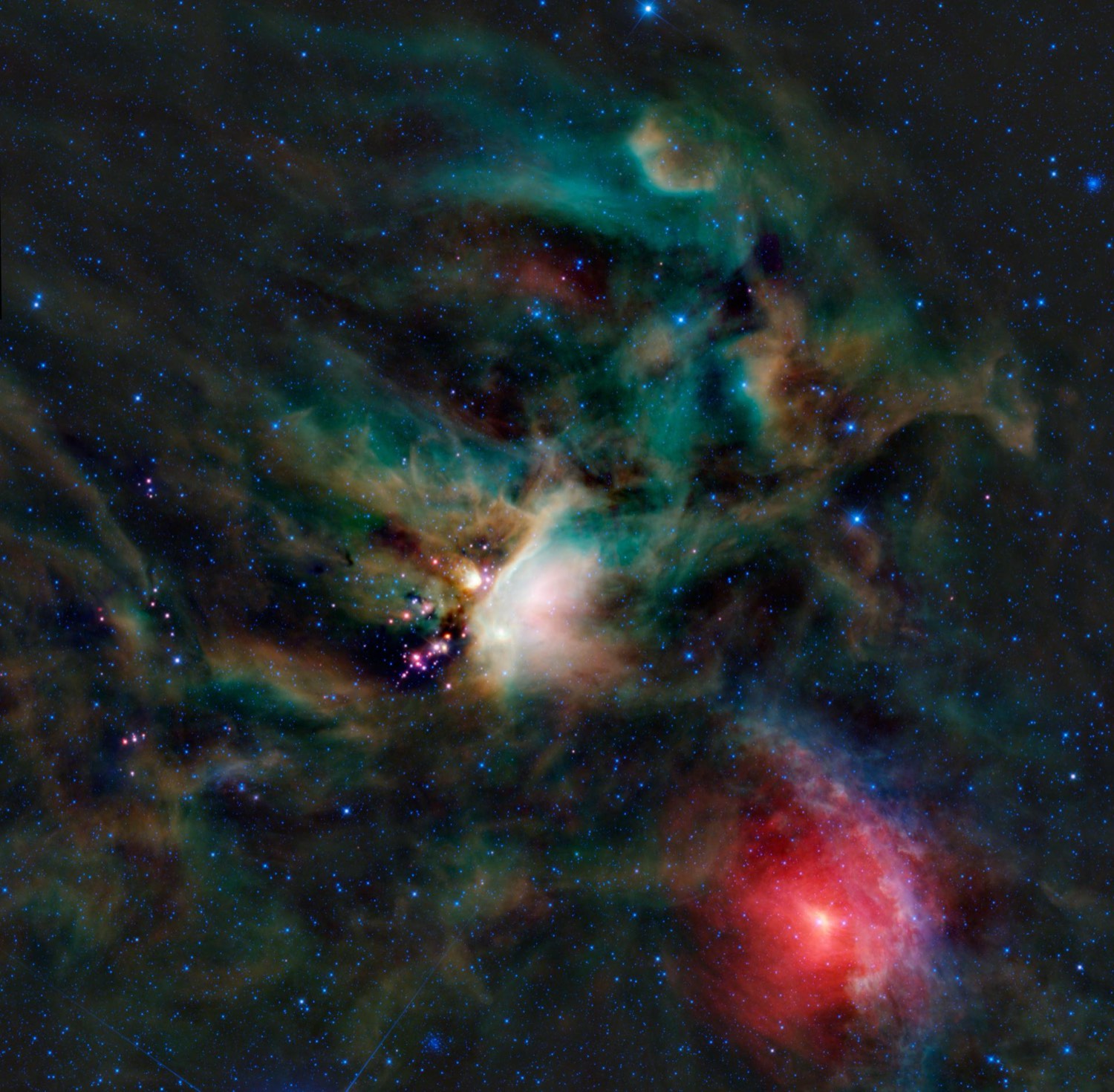
The Rho Ophiuchi cloud complex in infrared light from NASA's WISE telescope. In the night sky this region sits right beside Antares.
Image: NASA/JPL-Caltech/UCLA (public domain)
Antares is the star you notice in Scorpius before you notice anything else. It's bright and noticeably orange-red, low in the south for most of the Northern Hemisphere on summer evenings and high overhead for readers in Australia, southern Africa and South America. Its name is often translated as "rival of Mars," because the two are easy to confuse.
Right now the Moon is passing in front of it, or very nearly, every month.
A star the Moon can actually hide
The Moon's path among the stars wobbles over an 18.6-year cycle. For a few years at a time that path runs straight across Antares, and every time the Moon comes round, about every 27.3 days, it covers the star for observers somewhere on Earth. We're inside one of those runs now, and it continues into 2028.
Because the Moon is close to us, people in different places see it in slightly different positions against the stars. A pass that's a full occultation in one country can be a near miss in another, and happen in daylight or below the horizon in a third. The table gives the moment when the Moon's center comes closest to Antares as seen from Earth's center, which tells you which nights to watch.
| Closest pass (UTC) | Moon lit | Notes |
|---|---|---|
| Jan 31, 2027 · ~23h | 27% | Waning crescent |
| Feb 28, 2027 · ~07h | 49% | Near last quarter, dark leading edge |
| Mar 27, 2027 · ~15h | 72% | Waxing gibbous |
| Apr 24, 2027 · ~00h | 90% | Nearly dead-center pass |
| May 21, 2027 · ~08h | 99% | Full Moon covers Antares |
| Jul 14, 2027 · ~20h | 87% | Evening in Europe and Africa |
| Aug 11, 2027 · ~02h | 69% | Evening of Aug 10 in the Americas |
| Sep 7, 2027 · ~09h | 46% | Near first quarter |
| Oct 4, 2027 · ~18h | 24% | Thin evening crescent |
For your exact local timing, and whether the star disappears where you are, check the International Occultation Timing Association or an occultation app with your location set.
Why Antares doesn't just blink
When the Moon's edge covers an ordinary star, the star vanishes instantly, because it's effectively a point of light. Antares is different. It's a red supergiant, so large that if you put it where the Sun is, its surface would reach somewhere beyond the orbit of Mars. Even at around 550 light-years, its disk is big enough that the Moon takes a fraction of a second to cover it. Fast video sometimes shows the light fading rather than switching off.
You won't see that with your eye. What you might see is the second trick.
The companion that disappears separately
Antares has a smaller, hotter companion star, close enough that it's hard to split in most telescopes. Many observers describe it as greenish or bluish next to the orange primary, though that's partly a contrast effect. During an occultation, the Moon's edge reaches the two stars at slightly different times. So Antares fades out, and a few seconds later a faint spark next to it goes out too, or appears first on the way back out. Seeing that is a real treat.
Good nights for the Americas
Two passes stand out for North and South America. On the evening of April 23 local time, the bright gibbous Moon is close to Antares in the south-east, very near the moment of closest approach. And on the evening of August 10, a gibbous Moon sits right beside the star in the southern sky after dark. Whether either becomes a true occultation depends on exactly where you are, so check a local prediction. Even a near miss through binoculars is a striking sight: the red star, the bright Moon, and nothing else around them.
What we know about Antares itself
In 2017, astronomers using the European Southern Observatory's Very Large Telescope Interferometer produced the most detailed map yet of Antares' surface and atmosphere, showing turbulent, churning gas. It's losing mass and will one day end as a supernova. That might be next week, or a hundred thousand years from now. Until then, it keeps getting covered up by the Moon on a schedule you can plan around.
Sources and further reading
- Closest-approach times computed with PyEphem (geocentric, Moon center to Antares)
- International Occultation Timing Association (IOTA), local predictions
- ESO, observations of Antares' surface with the VLT Interferometer (2017)
Calculated times assume the locations named in the story and can shift slightly elsewhere. Found a mistake? Send a correction.