The Draconids Want You Outside at Dinnertime, Not 4 A.M.
Almost every meteor shower rewards people who wake up before dawn. The October Draconids do the opposite, and their history includes two of the most violent meteor storms ever recorded.
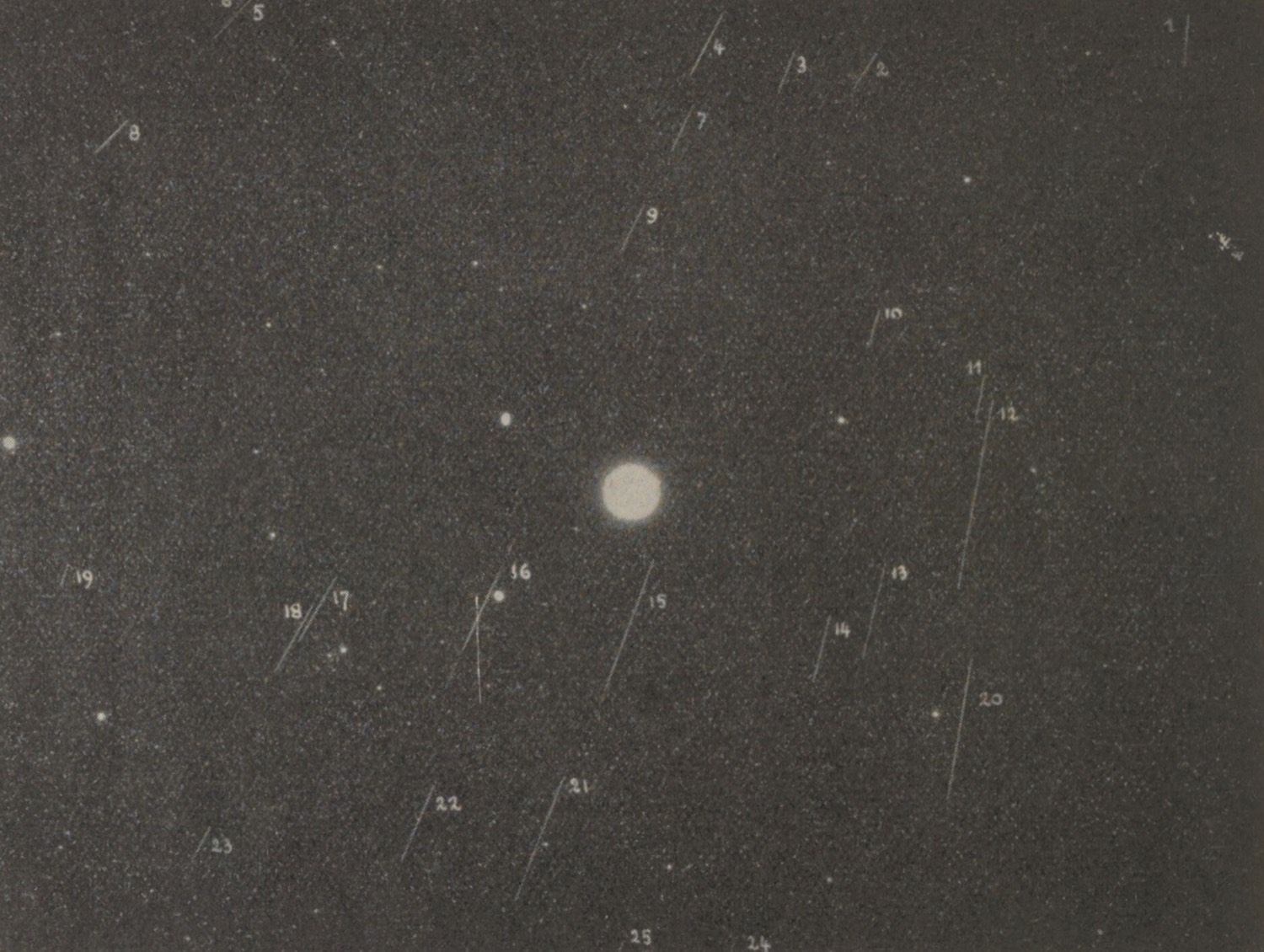
The 1933 Draconid storm photographed from France by Ferdinand Quénisset on October 9, 1933: 25 trails in under an hour on a single plate, centered on the star Vega.
Photo: F. Quénisset, public domain, via Wikimedia Commons
Here is a meteor shower you can watch with the porch light still on in the kitchen behind you, a plate of something on your knee, and no alarm clock involved. That alone makes the October Draconids unusual.
Why this one runs backwards
Most showers are morning events. After midnight your side of Earth faces forward along our orbit, so you plow into more debris, and most radiants climb highest in the small hours.
The Draconids break that rule. Their radiant sits in the head of Draco, the Dragon, a far-northern constellation that never sets for most of the Northern Hemisphere. It is actually highest at nightfall in early October, then sinks toward the north-west as the night goes on. So the best Draconid watching usually happens in the first few hours after dark.
The meteors are also among the slowest of any major shower, around 20 kilometers per second. Compare that with the 70 or so of the November Leonids. A Draconid looks lazy. It drifts.
A shower with a temper
On a normal year you'll see only a handful an hour, if that. Plenty of years, nobody notices it at all.
Then there's 1933. On October 9 of that year, observers across Europe watched rates explode into the thousands per hour for a short spell. The photograph at the top of this page was taken in France that night: one plate, less than an hour, 25 trails. In 1946 it happened again, this time over North America, with a full Moon in the sky and the meteors still pouring through it.
Smaller outbursts have arrived since: 1985, 1998 over Japan, a sharp burst over Europe in 2011 that reached several hundred an hour, a strange 2012 episode that radar caught much better than human eyes did, and a respectable surge in 2018.
The cause is the shower's parent, Comet 21P/Giacobini–Zinner, which loops around the Sun every six and a half years or so. Fresh streams of its dust sometimes sit right in Earth's path, and when we cross one the sky lights up for an hour or two.
The Draconids have produced two of the most intense meteor storms in the modern record. They have also produced dozens of completely forgettable evenings.
The 2027 outlook
We're not aware of a published model calling for a big outburst in 2027, so plan for an ordinary year and treat anything more as a bonus.
The Moon will be in the way early on. On October 8, 2027 it's a waxing gibbous, about 60 percent lit, sitting in the southern sky after sunset. From San Antonio it doesn't set until about 2:08 a.m. Central, and that's well after the radiant has slid low. Your best tactic is to keep the Moon behind a house or a tree and look north, where the sky is darkest and the radiant is.
Who can see them
Draco is a northern constellation. From the United States, Canada, Europe, North Africa, the Middle East, India, China and Japan, the radiant is up all evening. Near the equator it's low. Across most of the Southern Hemisphere it doesn't rise at all, and the shower is invisible.
For readers in Australia, South Africa or Argentina, this isn't your shower. You'll get your turn with the Phoenicids in December, which we've covered separately.
A note on that old photograph
In 1933, most meteor work was done by eye and by hand, with tally sheets and pencils. A glass plate that caught 25 meteors in under an hour was a major piece of evidence, and it still gets reproduced nearly a century later. Today a cheap camera on a tripod, set to take long exposures all evening, can do the same job. If the Draconids ever storm again, there will be thousands of plates. Yours could be one of them.
Sources and further reading
- International Meteor Organization, meteor shower calendar
- NASA Science, Comet 21P/Giacobini–Zinner
- Moon phase and moonset computed with PyEphem for San Antonio, Texas
Calculated times assume the locations named in the story and can shift slightly elsewhere. Found a mistake? Send a correction.