The Phoenicids: A December Shower Born From a Comet That Went Missing for 184 Years
Found in 1819, lost for nearly two centuries, then recognized again as a faint "asteroid" in 2003. Its dust gave sailors near Antarctica a spectacle in 1956. On December 2, the evening sky is dark for it.
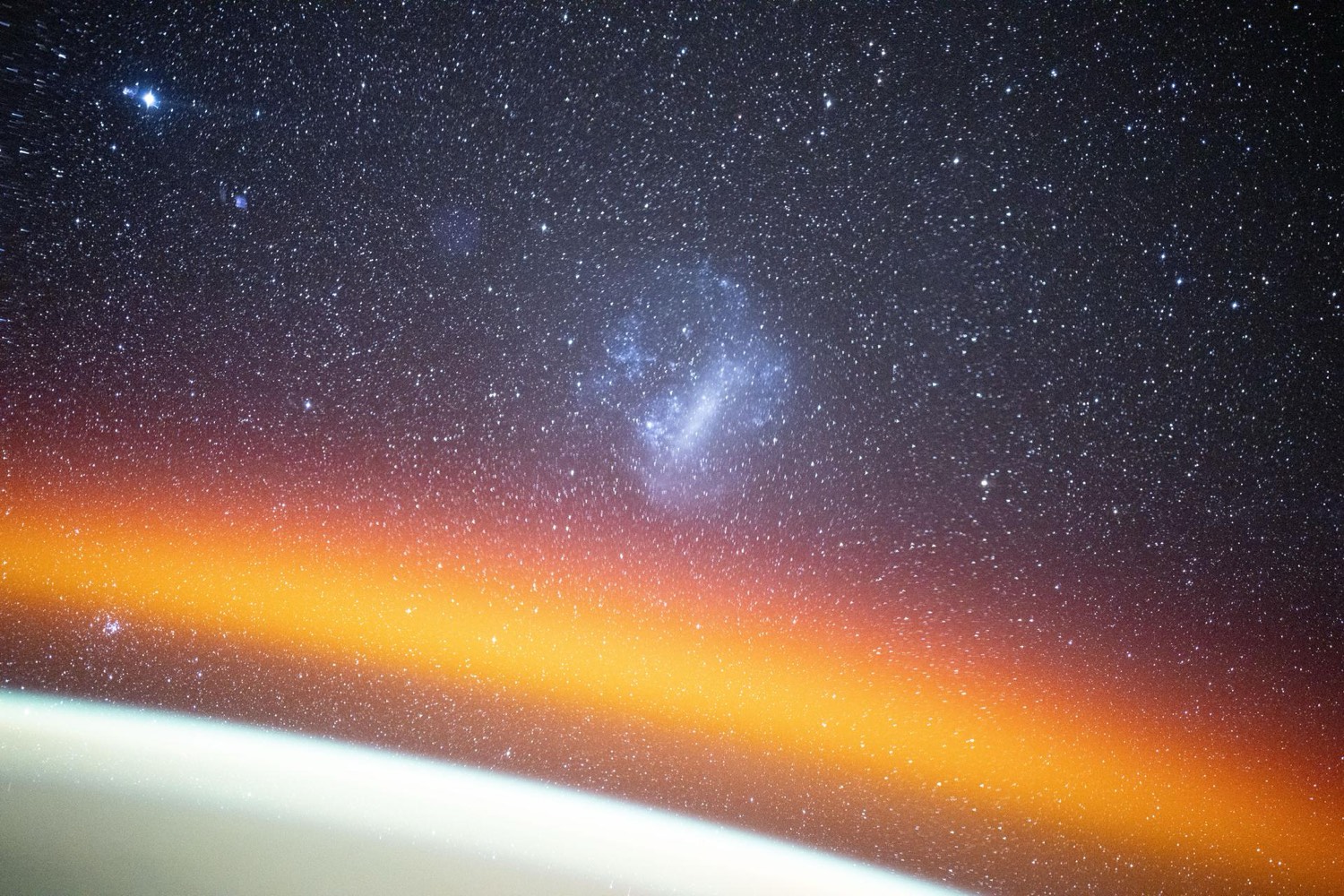
The Large Magellanic Cloud above Earth's airglow, photographed from the International Space Station on November 26, 2024. The Phoenicid radiant sits in the same deep-southern part of the sky.
Photo: NASA/Don Pettit (public domain)
In November 1819, an astronomer named Jean-Jacques Blanpain, working at Marseille, picked up a comet. People tracked it for a few weeks. Then it faded and was never seen again, or at least that's what everyone believed for the next 184 years.
The comet that hid in plain sight
In late 2003, the Catalina Sky Survey in Arizona found a faint object it catalogued as an asteroid, 2003 WY25. Orbit calculators noticed something odd. Run its path backwards and it lined up with Blanpain's lost comet. Later observations caught a wisp of activity around it, enough to confirm it was a comet after all, though a very weak one, probably a fragment of something bigger that broke up long ago. It now goes by 289P/Blanpain.
That breakup matters, because a comet falling apart sheds a lot of dust very quickly.
The night the Phoenicids arrived
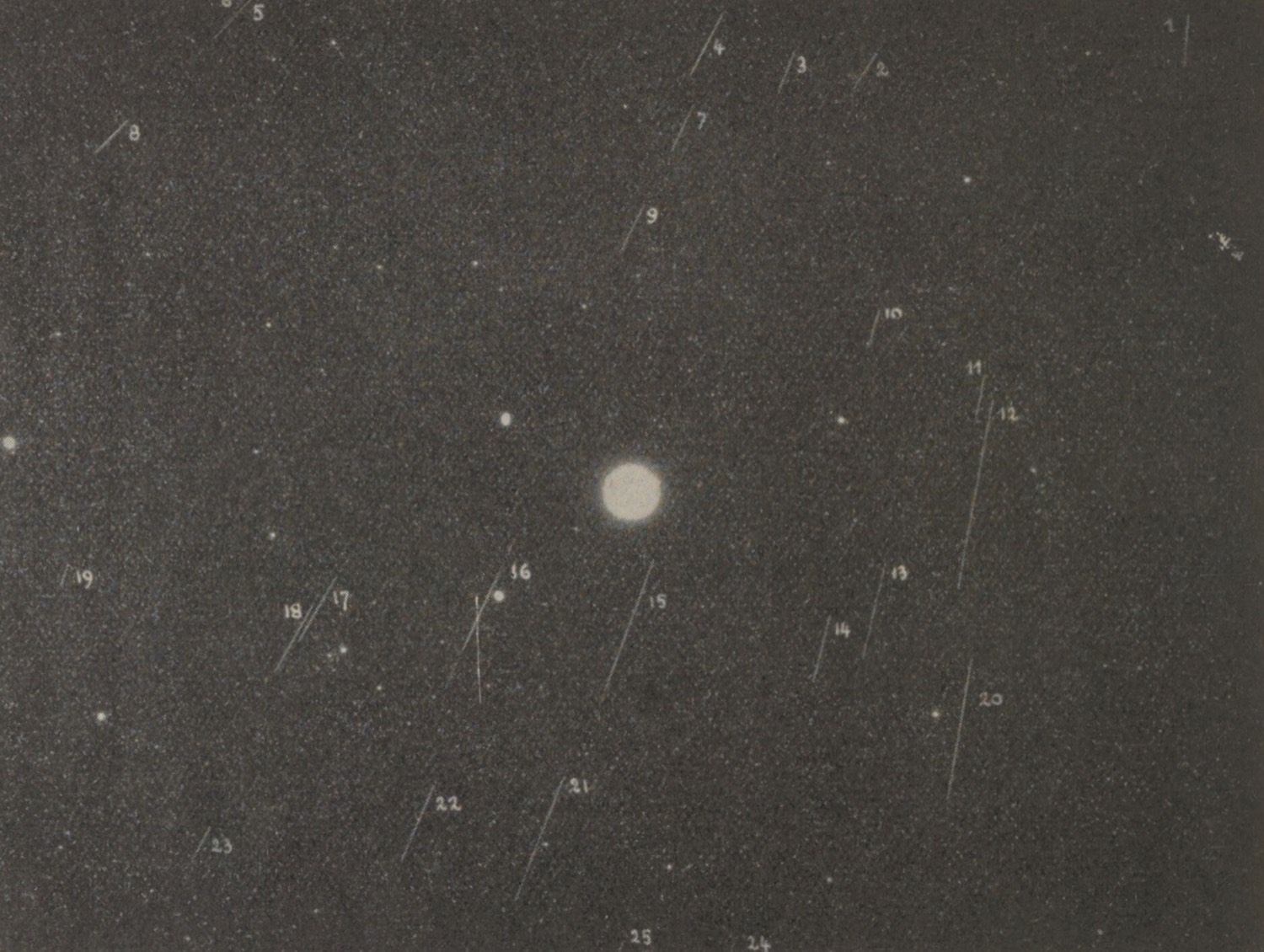
On December 5, 1956, observers in the Southern Hemisphere, including members of a Japanese Antarctic expedition on board the ship Sōya in the Indian Ocean, saw a shower nobody had catalogued. Rates reached something like 100 meteors an hour. The meteors came from the faint southern constellation Phoenix, and the shower was named for it.
It never repeated at that level. For decades the Phoenicids were mostly a footnote, a weak shower that some years seemed to vanish entirely. Then researchers including Peter Jenniskens connected the stream to Blanpain's comet and its old breakup, and predicted Earth would run through some of that debris again on December 1, 2014. Observers in the right places did record activity that night, but it was modest, a reminder that predicting old, scattered dust is hard.
What to expect on December 2, 2026
Honestly? Low numbers. Plan on a few meteors an hour from a dark site, with the chance of a surprise being small but real.
The good news is the Moon. It's a waning crescent about 37 percent lit, and it doesn't rise until after 2 a.m. local time in Texas, with a similar picture across most of the world. That leaves the whole evening dark, and evening is exactly when the Phoenicid radiant is best placed.
Where it's worth trying
The radiant sits around 45 degrees south of the celestial equator. That geography decides everything.
- Southern Hemisphere: Australia, New Zealand, South Africa, Chile, Argentina, southern Brazil. The radiant is high in the south-west after dark. This is your shower.
- Tropics: India, Southeast Asia, East Africa, Central America. The radiant is lower but up for a few hours after sunset. Worth a look.
- Southern US: From South Texas the radiant gets roughly 15 degrees above the southern horizon in the early evening. Meteors from it will skim in from the south, often long and low. Possible, but you'll need a clear southern view.
- Europe, Canada, northern US: Below the horizon. Not this one.
Why bother with a weak shower
Because the story is good, and because a dark December evening in the Southern Hemisphere is a warm, comfortable one. Spread a blanket, look up at the Magellanic Clouds, and keep half an eye on the south. If a few slow meteors drift out of Phoenix, you'll be watching the remains of a comet that went missing before anyone alive today was born, and was only found again by accident.
Sources and further reading
- International Meteor Organization, meteor shower calendar
- Minor Planet Center, 289P/Blanpain
- Jenniskens, P. et al. (2005), "Meteor showers from the debris of broken comets: D/1819 W1 (Blanpain)," Astronomical Journal
Calculated times assume the locations named in the story and can shift slightly elsewhere. Found a mistake? Send a correction.