Delta Cephei Pulses Every 5 Days, 9 Hours. That Rhythm Is How We Measured the Universe
A modest star near the north pole of the sky gave its name to a whole class of variables, and a Harvard astronomer named Henrietta Swan Leavitt turned their beat into a ruler for the cosmos. You can watch it pulse this autumn.
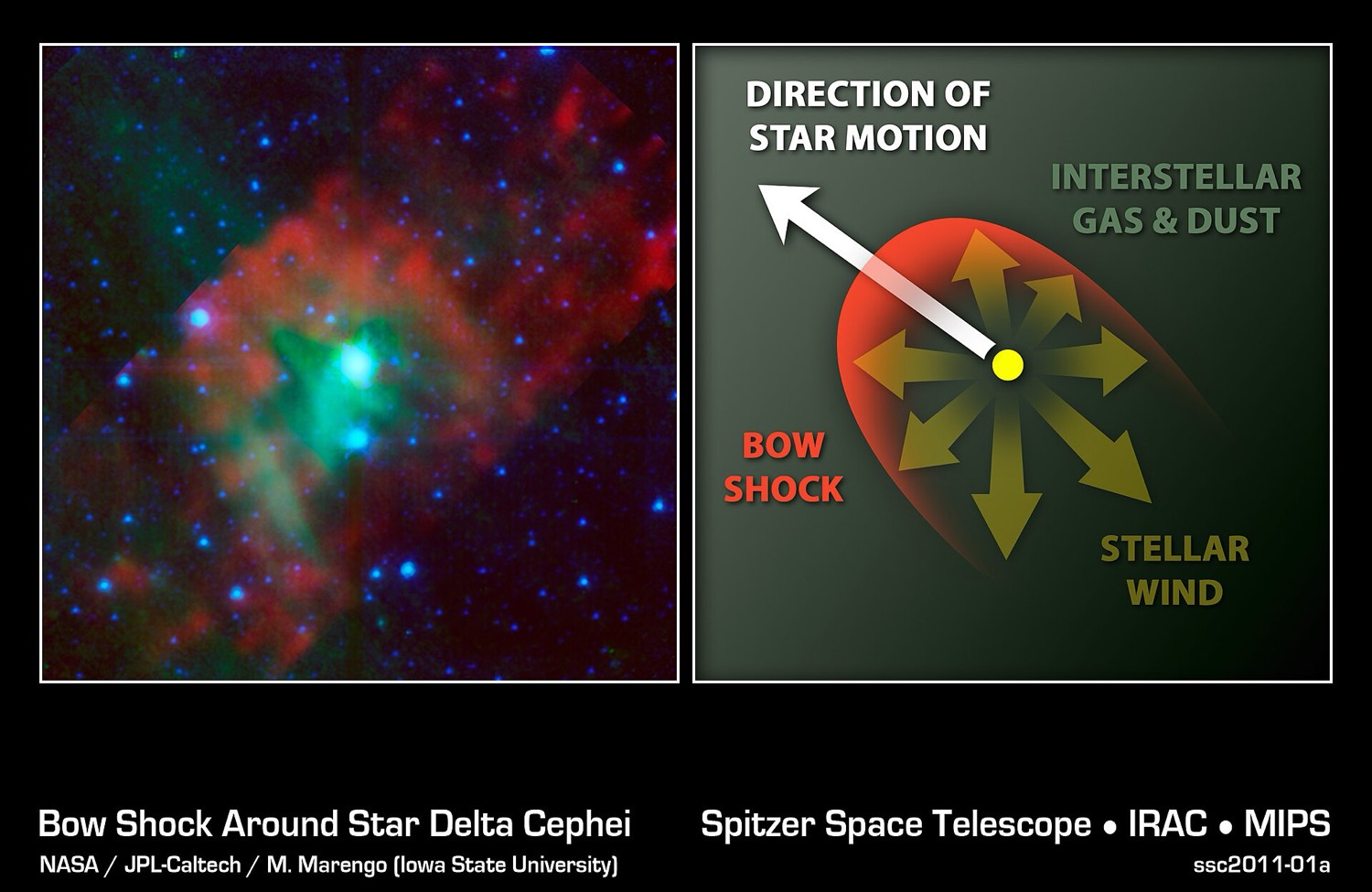
Delta Cephei and the bow shock it pushes through space, seen in infrared by NASA's Spitzer Space Telescope. The finding showed the star is shedding mass.
Image: NASA/JPL-Caltech/M. Marengo (Iowa State) (public domain)
Look north on an autumn evening and you'll find Cepheus, a constellation shaped roughly like a child's drawing of a house, with a pointed roof. Near one corner of its base sits a fourth-magnitude star that doesn't look like much. Watch it for a week, though, and it changes.
A star with a heartbeat
Delta Cephei brightens and fades on a schedule of 5 days, 8 hours and 47 minutes. It isn't eclipsed by anything. The star itself is pulsing: swelling, cooling and dimming, then shrinking, heating and brightening again. Its brightness runs from about magnitude 3.5 down to 4.4.
The shape of the cycle is lopsided. It climbs to maximum quickly, in about a day and a half, then takes nearly four days to sink back. Once you've seen that rhythm, it's oddly satisfying.
Its variability was spotted in 1784, and it became the namesake of an entire class of stars, the Cepheid variables. That might have stayed a curiosity. It didn't, because of one person.
The woman with the photographic plates
In the early 1900s, Henrietta Swan Leavitt worked at the Harvard College Observatory as one of the "computers," the women hired to measure and catalog stars on glass photographic plates, often for very little pay. She was assigned variable stars in the Small Magellanic Cloud, a small galaxy visible from the Southern Hemisphere.
She noticed something no one else had. Among the Cepheids in that cloud, the brighter stars had longer cycles. Since all the stars in the cloud are at roughly the same distance, that meant a Cepheid's true brightness was tied to its pulse rate. In 1912 she published the relationship for 25 stars.
That one finding changed astronomy. Measure how long a Cepheid takes to pulse, and you know how bright it really is. Compare that with how bright it looks, and you know how far away it is. Cepheids became cosmic yardsticks.
Leavitt never got to see what her discovery made possible. She died in 1921, before Cepheids were used to show that other galaxies exist.
From a house-shaped constellation to other galaxies
In 1923 Edwin Hubble found a Cepheid in what was then called the Andromeda Nebula. Using Leavitt's relationship, he showed it was far too distant to be inside our Milky Way. Andromeda was another galaxy. Soon after, Cepheids helped show that the universe is expanding. Today they're still one of the first rungs on the ladder astronomers use to measure the expansion rate, a value that is currently the subject of a long-running scientific argument.
Delta Cephei itself turned out to be complicated. NASA's Spitzer Space Telescope found it plowing a bow shock through space and losing mass, as shown in the image above. Precise distance measurements put it at roughly 890 light-years.
Watching it yourself
- Find Cepheus high in the north on autumn and early winter evenings for the Northern Hemisphere. For much of the US, Europe and Asia it never sets.
- Find Delta at one corner of the house's base, where it makes a small, tight triangle with Zeta and Epsilon Cephei.
- Compare. Two neighbors make perfect reference points: Zeta Cephei, at about magnitude 3.4, is as bright as Delta at its peak. Epsilon Cephei, about magnitude 4.2, matches it near its faintest.
Who can see it
Delta Cephei sits about 58 degrees north of the celestial equator, so it's easy from the Northern Hemisphere and low or invisible south of about 30 degrees south. Southern readers have a better consolation prize than most: the Small Magellanic Cloud itself, where Leavitt's Cepheids live, is up in your evening sky.
Sources and further reading
- Leavitt, H. S. & Pickering, E. C. (1912), "Periods of 25 Variable Stars in the Small Magellanic Cloud," Harvard College Observatory Circular 173
- AAVSO, Variable Star of the Season: Delta Cephei
- Marengo, M. et al. (2010), Spitzer observations of the Delta Cephei bow shock, Astrophysical Journal
Calculated times assume the locations named in the story and can shift slightly elsewhere. Found a mistake? Send a correction.