Sirius Has a Tiny, Impossibly Heavy Partner, and It's Near Its Easiest to Spot
Next to the brightest star in the night sky sits a white dwarf the size of Earth with the mass of the Sun. It was predicted before it was seen, and for the next few winters it sits close to its widest from its dazzling companion.
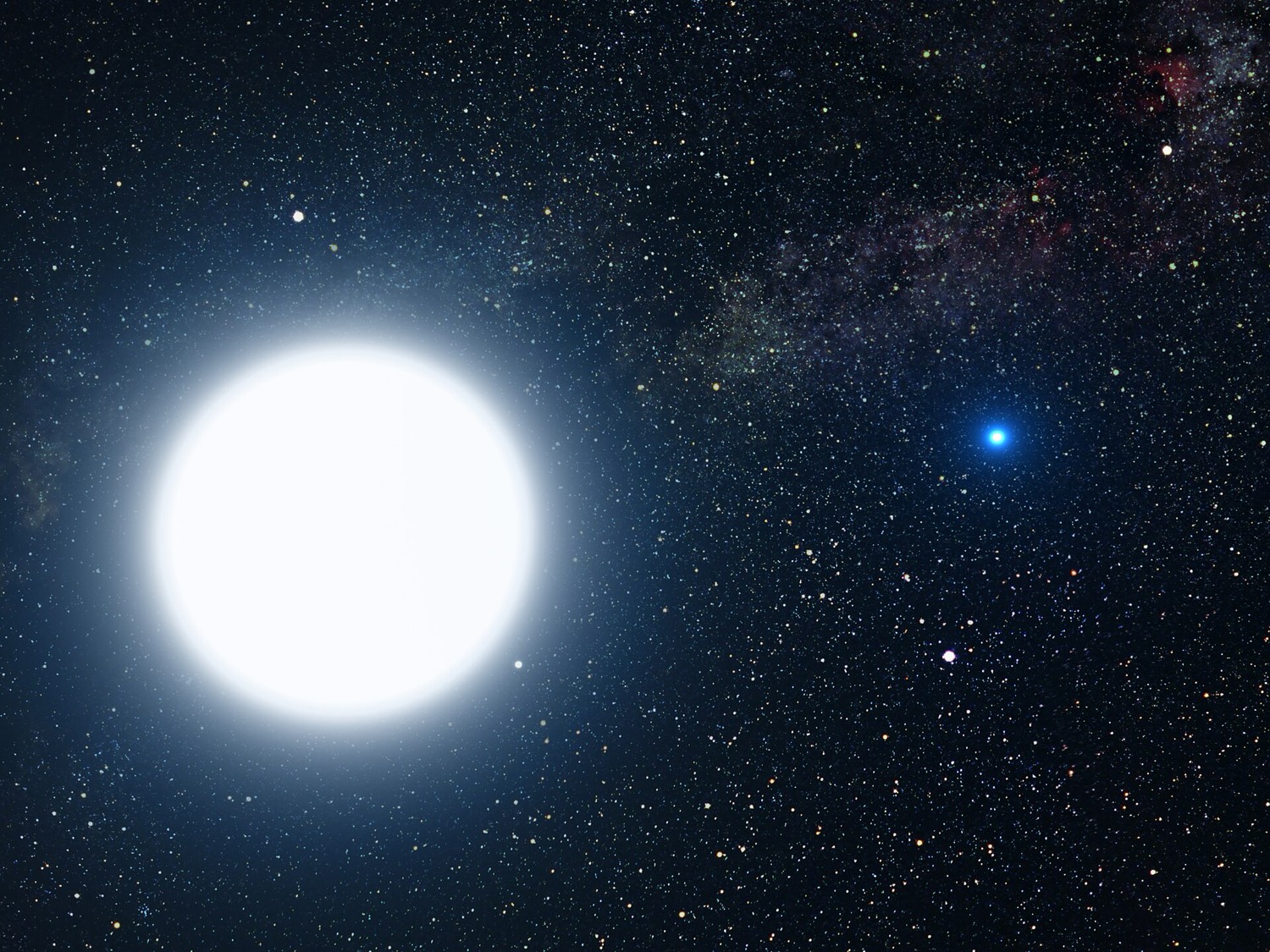
An artist's impression of Sirius A and its white dwarf companion Sirius B. This is an illustration, not a photograph; in a telescope Sirius B is a faint point almost lost in Sirius A's glare.
Illustration: NASA, ESA and G. Bacon (STScI) (public domain)
On winter evenings Sirius is impossible to miss. It's the brightest star in the night sky, low in the south-east after dark for northern observers, flashing white, blue and sometimes red when it's close to the horizon. That flashing is our atmosphere, not the star.
What's harder to see is the thing right next to it.
Predicted before it was found
In 1844 the German astronomer Friedrich Bessel noticed that Sirius wasn't moving across the sky in a straight line. It wobbled, slowly, over about half a century. Bessel concluded something unseen was pulling on it, a companion massive enough to tug the brightest star in the sky.
Nobody could find it. Then, on January 31, 1862, the American telescope maker Alvan Graham Clark was testing a new 18.5-inch lens, at the time the largest refractor in the world. He pointed it at Sirius and saw a faint speck right next to it. Bessel's invisible companion had turned up, on the first night someone looked with a good enough lens.
It became known as Sirius B, and informally the Pup, since Sirius is the Dog Star.
The size of Earth, the mass of the Sun
The puzzle came later. Sirius B is about 10,000 times fainter than Sirius A, yet the wobble showed it had roughly the mass of our Sun. In 1915 Walter Adams took its spectrum and found it was hot, white hot. A hot star that's that faint must be tiny.
It is. Sirius B is close to the size of Earth while holding about as much mass as the Sun. A teaspoon of its material would weigh several tons. It's a white dwarf, the exposed core of a star that ran out of fuel long ago, and it was one of the first such objects ever recognized. The Hubble Space Telescope later measured how strongly its gravity stretches the light leaving it, which pinned down its mass more precisely.
A star with the mass of the Sun, squeezed into a ball the size of Earth, hiding in the glare of the brightest star in the sky.
Why now is a good time
The two stars circle each other every 50 years or so. As seen from Earth, their separation swings from about 3 arcseconds at closest to about 11 at widest. They were tight in the 1990s. In the last few years they've been near their widest, and they'll stay comfortably apart for the next several winters before closing in again toward the 2040s.
Eleven arcseconds is a gap you could split easily if both stars were similar. The problem is the contrast. Sirius A is so bright it drowns its companion in glare and atmospheric shimmer.
How to try for the Pup
- Telescope: an 8-inch or larger telescope gives you a real chance. Smaller scopes have caught it on exceptional nights.
- Air: steady air matters more than anything. Wait for a night when the stars barely twinkle, and catch Sirius when it's highest. Around New Year that's near midnight; by February it's mid-evening.
- Magnification: go high, 200x or more, to spread the stars apart.
- Tricks: some observers place the bright star just outside the field of view, or use a hexagonal mask over the front of the telescope, which pushes the glare into spikes and leaves dark gaps where the Pup can show.
A star for every country
Sirius sits about 17 degrees south of the celestial equator, so it rises for almost everyone on Earth except people in the far Arctic. In the Southern Hemisphere it rides high on summer evenings. It shaped calendars, too: in ancient Egypt, Sirius reappearing in the dawn sky after months hidden by the Sun's glare came around the time of the Nile's annual flood.
Next time you see it glittering over a rooftop, remember there's a dead star the size of our planet right beside it, invisible to the eye and still giving the brightest star in the sky a push.
Sources and further reading
- Bond, H. E. et al. (2017), "The Sirius System and Its Astrophysical Puzzles," Astrophysical Journal
- ESA/Hubble, "Hubble measures the mass of a lone white dwarf companion" (Sirius B, 2005)
- US Naval Observatory, Washington Double Star Catalog
Calculated times assume the locations named in the story and can shift slightly elsewhere. Found a mistake? Send a correction.