The False Dawn: How to See the Zodiacal Light, a Glow Made of Dust Between the Planets
A tilted cone of soft light rises from the horizon before dawn in autumn and after dusk in spring. It's sunlight bouncing off dust spread through the solar system. Here are the moonless windows from Texas this season.
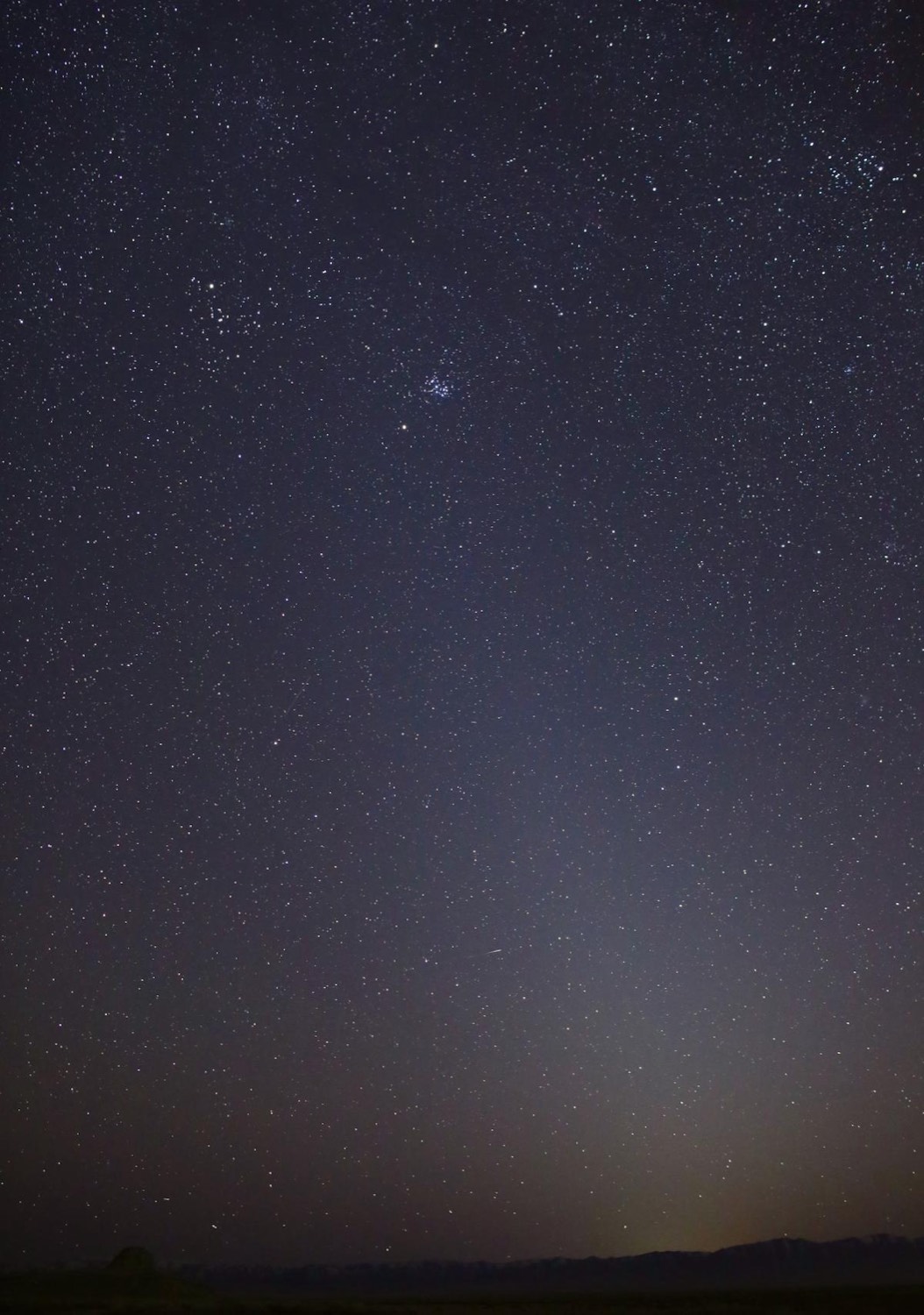
The zodiacal light over Skull Valley, Utah, on March 1, 2021. The Pleiades are near the top of the glow, with Mars just below.
Photo: NASA/JPL-Caltech (public domain)
Out here in West Texas, people who drive ranch roads before dawn sometimes mention a strange glow in the east, well before the sky should be getting light. It's not a town. It's not the sunrise. It's tilted, faint, and shaped a bit like a searchlight beam pointed up from the horizon. Then real twilight comes and it's gone.
That's the zodiacal light. Many cultures noticed it long ago. In Islamic tradition the distinction between a "false dawn" and the "true dawn" matters for the timing of the morning prayer, and the false dawn is generally understood to be this glow.
What you're looking at
The solar system is dusty. Between the planets there's a thin haze of tiny grains, most smaller than a grain of sand, spread mainly along the plane where the planets orbit. Sunlight scatters off that dust, and from a dark site we see it as a soft band rising from where the Sun is hidden below the horizon.
Where the dust comes from is still being worked out. Comets shed a lot of it, and so do collisions between asteroids. In 2021 a team studying data from NASA's Juno spacecraft, which recorded dust impacts on its way to Jupiter, suggested Mars might also be a source, with dust escaping the planet. That idea is still being tested, but it shows how much is still unknown about something you can see with your bare eyes.
Why the season matters
The glow follows the ecliptic, the Sun's path across the sky. The zodiacal light is easiest to see when that path stands steeply up from the horizon, so the glow rises high instead of lying flat in the haze.
For the Northern Hemisphere, that happens:
- Before dawn in autumn, roughly September to November, looking east.
- After dusk in late winter and spring, roughly February to April, looking west.
In the Southern Hemisphere it's the opposite: spring mornings and autumn evenings.
The moonless windows from Texas
Moonlight hides the zodiacal light completely, so you need nights when the Moon is below the horizon at the darkest point before dawn, or after dusk. We checked every date from San Antonio. The same windows work for most of Texas and much of the southern United States, give or take a day:
| Season | Moonless windows |
|---|---|
| Mornings, look east | Nov 7–21, 2026 · Dec 6–20, 2026 |
| Evenings, look west | Feb 1–7 · Feb 22–Mar 8 · Mar 23–Apr 7, 2027 |
The November mornings are the best of these, because autumn mornings put the glow at its most upright for northern observers.
You need a properly dark sky
This is the hard part. Even moderate city light wipes it out. In Texas, places like Big Bend, the Davis Mountains and the darker parts of the Hill Country are where it shows best. Big Bend National Park is an International Dark Sky Park, and on a clear November morning there the zodiacal light can be bright enough that first-time visitors assume it's dawn.
If you get a really dark night, look for two bonus sights. The gegenschein, or counterglow, is a faint oval patch exactly opposite the Sun, best seen around midnight. Very rarely, a faint zodiacal band links the two across the whole sky.
Why it's worth the early alarm
Most of what you see in the night sky is far away: stars are light-years off, galaxies millions. The zodiacal light is local. It's sunlight bouncing off dust that's floating among the planets, some of it not far beyond Earth's orbit. It's about the closest thing to seeing the solar system itself, as a place with contents, rather than a set of dots.
Sources and further reading
- Moonless dawn and dusk windows computed with PyEphem for San Antonio, Texas
- Jorgensen, J. L. et al. (2021), "Distribution of interplanetary dust detected by the Juno spacecraft," JGR Planets
- International Dark-Sky Association (DarkSky International), Big Bend
Calculated times assume the locations named in the story and can shift slightly elsewhere. Found a mistake? Send a correction.