Hera Reaches the Scene of the Crash: Europe's Probe Is Due at the Asteroid NASA Deliberately Hit
In 2022, NASA's DART spacecraft slammed into a small asteroid moon and changed its orbit. This November, ESA's Hera is scheduled to arrive and measure exactly what that impact did. It's the second half of humanity's first planetary-defense test.
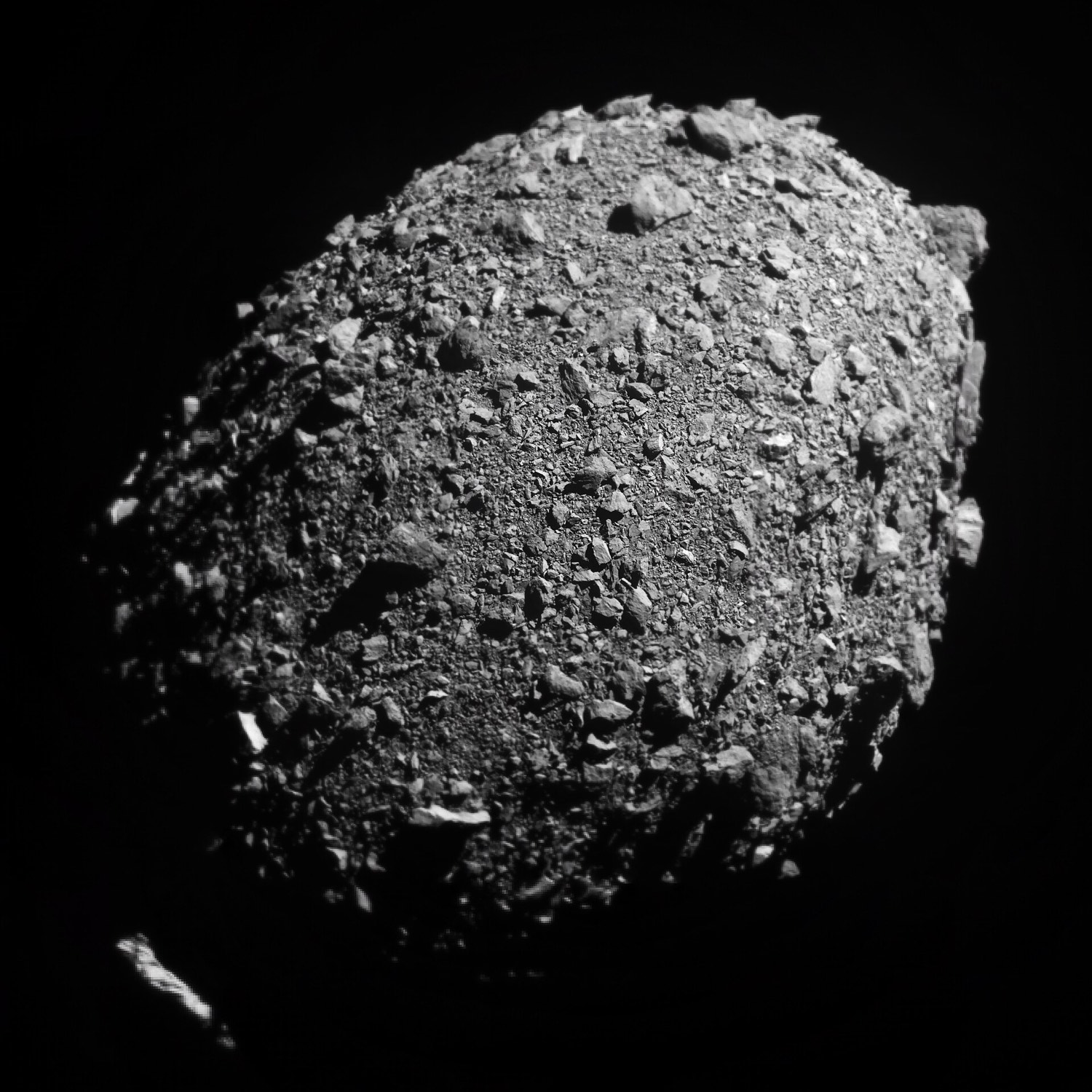
Dimorphos stacked from the final images DART sent back moments before impact on September 26, 2022. Hera is going back to see what that impact left behind.
Image: NASA/Johns Hopkins APL, stacked by Eydeet (public domain), via Wikimedia Commons
On September 26, 2022, a NASA spacecraft about the size of a small car flew straight into an asteroid at more than 6 kilometers per second. It was meant to. The Double Asteroid Redirection Test, DART, was the first real-world attempt to change an asteroid's path on purpose.
It worked. Now Europe is sending someone back to the scene.
What DART did
The target was Dimorphos, a small moon, about 160 meters across, circling a larger asteroid called Didymos, about 780 meters across. Neither poses any threat to Earth. They were picked because a two-body system lets astronomers measure the result from the ground: watch how long Dimorphos takes to go around Didymos, before and after the hit.
Before impact, one orbit took about 11 hours and 55 minutes. Afterwards, it took around 32 to 33 minutes less. That's far more than the minimum NASA had hoped for, partly because the collision blasted out a huge plume of rock and dust, and that recoil added an extra push.
DART was destroyed in the impact, so it couldn't look at what it had done. That was always Hera's job.
The detective arrives
ESA's Hera launched on October 7, 2024. On the way it swung past Mars in March 2025, taking pictures of the small Martian moon Deimos from an unusual angle. A deep-space maneuver in early 2026 put it on course to reach Didymos in November 2026, about a month earlier than first planned.
Once there, the plan is to study the pair for at least six months. Among the questions:
- How heavy is Dimorphos? Without the mass, you can't work out exactly how much push DART delivered. Hera will measure it from the way the two bodies tug on each other.
- What does the crater look like? Or did DART reshape the whole moonlet? Some studies suggest the impact may have changed Dimorphos's shape significantly.
- What's inside? A loose pile of rubble behaves very differently from a solid rock when you hit it.
DART answered "can we nudge an asteroid?" Hera is there to answer "exactly how hard did we push, and why?"
Two tiny passengers
Hera carries two shoebox-sized CubeSats, named Milani and Juventas. Once Hera arrives, they're due to be released to fly closer than the main spacecraft safely can. Juventas carries a low-frequency radar designed to see inside Dimorphos, the first radar probe of an asteroid's interior. Both may try to land at the end of their missions.
Why this matters for everyone, everywhere
Asteroid impacts are rare but not imaginary. If astronomers ever find one on a collision course, the most practical response, given enough warning time, is likely to be something like DART: hit it early and change its orbit slightly, so a tiny change grows into a clean miss over years.
To do that with confidence, you need to know how real asteroids respond to being hit. That's the whole point of Hera. Every country on Earth shares the same sky and the same risk, which is why the result is planetary defense, not national.
A tidy experiment
There's something satisfying about the whole arrangement. One agency builds the hammer. Another builds the magnifying glass. The target is a harmless pair of rocks millions of kilometers away, chosen precisely because it doesn't matter if we change them. If Hera arrives on schedule this month, the most important experiment in planetary defense so far will finally have both of its halves.
Sources and further reading
- ESA, "Hera targets early arrival at Didymos asteroids"
- ESA, "Hera on course for asteroid rendezvous" (March 2026)
- NASA, DART mission results
Calculated times assume the locations named in the story and can shift slightly elsewhere. Found a mistake? Send a correction.